
By William del Strother, VP of Innovation
AI agents can help anti-piracy investigators explore malicious websites, analyse streaming infrastructure and uncover emerging piracy techniques. But giving autonomous agents access to infrastructure controlled by criminals introduces a security challenge: how do you investigate hostile environments without exposing your own systems to attack?
We have previously discussed how sandboxes keep AI-assisted development safe, but content-protection work means sending AI agents into the internet’s most hostile corners. In this article, we examine how to do this without exposing our own systems to attack, and the importance of using AI governance tools to manage it across the whole team.
We previously illustrated the serious problem of prompt injection, where instructions buried in content an AI reads can quietly take over what it does. The standard answer to this threat is to give AI agents room to work fast inside a sandbox, with network access limited to approved destinations, and for most organisations it’s enough. That way, even a successful injection is contained and prevented from reaching anything sensitive.
AI agents are part of everyday work across our engineering and operations teams, and consistent governance is crucial, especially as our anti-piracy work takes them to the place any security team would tell you to avoid: pirate infrastructure itself.
Prompt injection has left the lab
LLMs can be steered by surprisingly simple attacks hidden in web pages, documents, media and open-source libraries. Two recent cases illustrate how real this danger has become.
In the first, an attacker hid instructions in the title of a GitHub issue on a popular open-source project. The project's AI triage bot read the title and ran the attacker's commands, opening a path to the credentials used to publish the project's software. A tampered release was later published.
In the second, a security researcher showed that simply asking an AI coding agent to summarise a web page could end with the attacker's code running on the user's computer. The agent's automatic safety checks, meant to protect against exactly this, didn't stop it, and in some cases even blocked the agent’s own attempt to shut the attack down. The vendor's response was telling: those checks are best-effort, and the real security boundary is isolation and control of network access.
That's the principle our sandboxes are built on. With every engineer running AI agents, policies need to be set centrally, applied consistently and visible across the whole organisation.
Why anti-piracy breaks the usual rules
The standard advice is to run AI agents in a sandbox and block access to anything potentially malicious, typically by allowing network traffic only to known, trusted sites. Then, even if an attacker manipulates your agent, it can't reach anything that would let it cause damage.
That approach is appropriate for many enterprise use cases. It doesn't work for us. The pirate sites we investigate are inherently untrusted. Many are run by organised criminal groups, and they're likely to be malicious in their own right. Prompt injection isn't the only threat. Agents investigating hostile infrastructure may also encounter malicious files, compromised services and deliberately manipulated intelligence, making robust isolation and access controls essential.
Yet that's exactly where AI is most valuable to us. Armed with our anti-piracy toolkit, AI agents can rapidly analyse the techniques and infrastructure behind pirate streams and servers, allowing our investigators to examine more services and identify emerging patterns more efficiently.
So the question we had to answer was this: how do we get all the benefits of AI against pirate infrastructure, without opening ourselves up to the prompt injection attacks those same sites could run against us?
Central governance for AI agents
AI governance tooling gives organisations centralised control, visibility and enforcement for AI agents. For us, three capabilities matter most:
-
Central network policies, configured once and consistently applied across approved AI agent environments.
-
Central management of tools and standards through shared sandbox configurations, packaging approved tooling, MCP (Model Context Protocol) servers and policies so everyone has easy access to best practice for AI coding, analysis and problem solving.
-
Full audit visibility, so we can see what our agents are doing, not just hope they're behaving.
Our anti-piracy work also highlights something specific to anti-piracy and other security-sensitive work: one sandbox isn't enough. You need different sandboxes for different jobs, each with its own centrally governed rules.
Two sandboxes, two jobs
Our answer is to split the work between isolated environments with separately enforced access policies, each governed centrally:
-
Piracy investigation. This sandbox is open to any pirate site, allowing powerful, flexible investigation, analysis and intelligence gathering against pirate organisations using our anti-piracy toolkit. But it's strictly closed to every sensitive Friend MTS system: no source code, no secrets, no internal data, and no customer data. Even if our guardrails failed and a pirate pulled off a prompt injection attack, the sandbox's isolation would significantly limit its potential impact, preventing the agent from accessing our sensitive internal systems and data.
-
Analysis and coding. This sandbox has access to our internal systems, source code and data, so we can build the next generation of our software with all the benefits of AI assistance. But it's strictly closed to the open internet, and especially to pirate sites. It reaches only selected resources we trust, and tests against mock pirate sites we host ourselves.
The two sandboxes are connected by one deliberate path. The investigation sandbox gathers intelligence on how pirate sites work and how they respond, for example, to scraping bots, suspicious browser fingerprints, or requests from different geographies. Findings cross over only after an investigator has reviewed them, and only as structured summaries of techniques and behaviour. No raw pages, scripts or files from pirate sites ever reach the analysis environment.
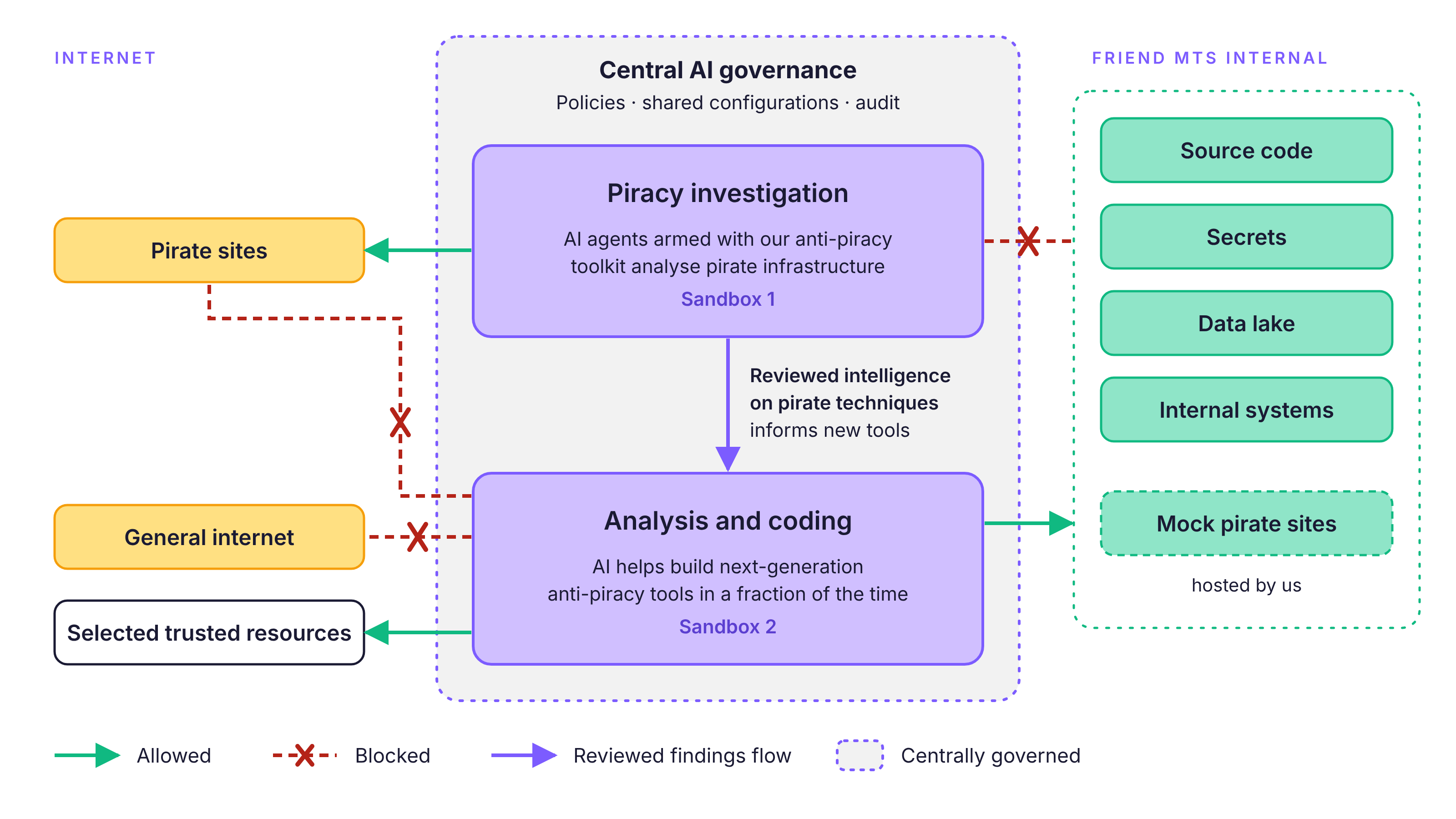
Each sandbox reaches only what its job needs. The investigation environment has no permitted access to our sensitive internal systems.
Ahead of pirates, without compromising security
Pirates move fast, and so do we. By separating hostile investigations from trusted development environments, we can use AI to accelerate anti-piracy innovation while keeping our own and our customers’ data well away from pirate infrastructure. This allows us to investigate emerging piracy techniques, respond to new threats and develop more effective content protection capabilities without unnecessarily exposing sensitive systems or information – the environment that touches hostile infrastructure never touches anything we need to protect..
We'll keep sharing what we learn as AI changes the fight against piracy.
Missed Part 1 of this series? Read How FMTS keeps AI-assisted development bulletproof.
If you want to learn more about our content and revenue protection solutions, contact the Friend MTS team today.